🍹 Havana's Bar Culture
From Hemingway's daiquiris at La Floridita to the mojito at La Bodeguita del Medio — Cuba invented the cocktail hour.
The Island's Spirit
It begins with sugar cane — the same vast fields that shaped Cuba's economy, its history, its tragedy, and its genius. Somewhere in that history, a Cuban distiller figured out that the molasses left over from refining sugar could be fermented and distilled into something extraordinary. That something was rum. And rum became Cuba.
Walk into La Floridita on Obispo Street in Old Havana and you'll find Ernest Hemingway's ghost still seated at the bar — he drank double frozen daiquiris here with religious devotion. Walk two blocks to La Bodeguita del Medio and you'll find the mojito written on the wall, dozens of languages scrawled in pen, proof that this drink conquered the world without ever leaving its homeland.
Cuban cocktails are not fancy. They don't require obscure bitters or artisanal ice spheres. They require excellent rum, fresh lime, a little sugar, and the right attitude. They are the drinks of fishermen, writers, revolutionaries, and grandmothers. They belong to everyone — which is exactly why they've endured.
This guide covers eight essential Cuban cocktails, from the oldest (the Canchánchara, born in the 19th century) to the most beloved (the Mojito, drunk by millions daily). Each comes with its history and an honest recipe. Drink well. Order these classics at the best paladares in Havana — many have rooftop bars with extraordinary views.
The Essential Eight
Eight drinks that define a culture. Every one made with Cuban rum. Every one with a story worth knowing before you drink it.
01 · The Classic
La Bodeguita del Medio, Havana
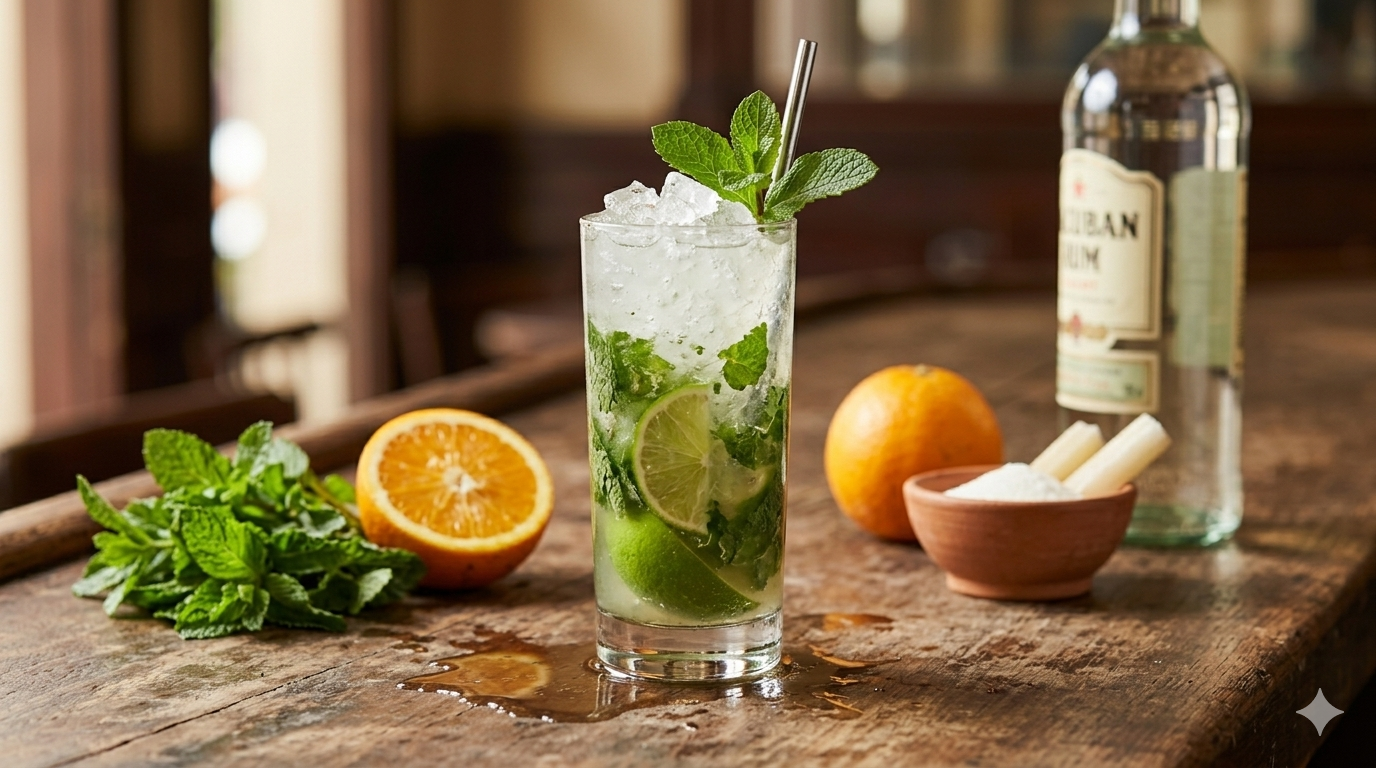
Born at La Bodeguita del Medio — a cramped, charismatic bar on Empedrado Street in Old Havana that has been squeezing limes since 1942. The Mojito may be Cuba's most famous contribution to the world's drinking culture, a drink so perfect in its simplicity that countless bartenders have tried to improve it and none have succeeded.
The secret is the muddling — press the mint gently, not aggressively. You want fragrance, not bitterness. The lime must be fresh. The rum must be Cuban. Everything else is negotiable.
Method: Muddle mint with sugar and lime in a highball glass. Add rum and stir. Fill with crushed ice, top with soda water. Garnish with mint sprig and lime wheel.
02 · Hemingway's Obsession
La Floridita, Obispo Street, Havana
The Daiquiri was invented in 1898 near the Daiquirí mine in eastern Cuba, where American mining engineer Jennings Cox ran out of gin and improvised with local rum, lime, and sugar. But it was La Floridita bar in Havana that elevated it to art form — and Hemingway who made it legend.
Papa Hemingway drank his frozen, without sugar, doubled. He called La Floridita "the cradle of the daiquiri." At its best, a classic daiquiri is three ingredients shaken aggressively until nearly frozen. Nothing else belongs.
Method: Combine all in a cocktail shaker with ice. Shake hard for 15 seconds until very cold. Double-strain into a chilled coupe glass. No garnish needed — the drink speaks for itself.
03 · The Revolutionary
Havana, circa 1900
In 1900, American soldiers arrived in Cuba following the Spanish-American War, bringing Coca-Cola — then a new American invention — with them. A captain mixed the Coke with local rum, squeezed in some lime, and raised his glass with a toast: "¡Por Cuba Libre!" — "To a Free Cuba!" A cocktail was born from a moment of political hope.
Don't call it a Rum and Coke in Havana. The lime is not optional. The ice must be plentiful. And for the love of the island, use Cuban rum.
Method: Fill a highball with ice. Add rum, squeeze in the lime, add the spent wedge to the glass. Pour Coke gently down the side. Do not stir aggressively — just a gentle fold. Garnish with lime.
04 · The Forgotten Masterpiece
Havana, 1920s Prohibition Era
During Prohibition, wealthy Americans flocked to Havana to drink legally and drink well. The El Presidente was created for them — a cocktail worthy of the presidential palaces of 1920s Cuba, a stirred drink of elegance and restraint. Named for Cuban President Mario García Menocal, it became the drink of Havana's golden age.
Less known today than its siblings, it deserves rediscovery. The grenadine is used by the drop — just enough for color and a whisper of sweetness. This is a bartender's drink.
Method: Combine all ingredients in a mixing glass with ice. Stir 30 seconds until well chilled. Strain into a chilled cocktail glass. Express orange peel over the surface and rim the glass.
05 · The Disputed Classic
Cuba (& Puerto Rico) — 19th Century
Cuba claims the Piña Colada was invented by 19th-century pirate Roberto Cofresí, who gave his crew a blend of rum, coconut, and pineapple to boost morale on the high seas. Puerto Rico counter-claims it vigorously. The truth, as with most cocktail history, is murky and wonderful.
What's not disputed: it tastes like a Caribbean vacation. Use fresh pineapple when possible. Real coconut cream, not the sweetened syrup. Blend until completely smooth and serve immediately.
Method: Blend all ingredients with ice until completely smooth. Pour into a chilled glass or a hollowed pineapple if you're feeling theatrical. Garnish and serve immediately.
06 · The Local Secret
Cuban Beaches, Everywhere
The Saoco is what Cubans drink on the beach when no one is watching. It requires nothing more than a young green coconut — cracked open with a machete — and a generous pour of rum into the coconut water still inside. No ice necessary when the coconut is cold. No glass necessary when you're on a beach.
It's devastatingly refreshing. The coconut water is naturally sweet and electrolyte-rich. The rum provides the authority. Together, they are summer distilled. If you ever find yourself on a Cuban beach, this is the drink you need.
Method: Combine rum and coconut water in a tall glass over ice. Stir gently. A squeeze of fresh lime brightens it considerably. Serve immediately.
07 · The Refined Sipper
Cuban Variation on a Classic
The Ron Collins is Cuba's answer to the Tom Collins — swap the gin for light Cuban rum and you have a drink that is somehow both more tropical and more elegant. It's a long drink, leisurely, meant to be nursed through an afternoon rather than downed quickly.
The key is balance: the lemon provides brightness, the sugar softens it, the soda adds life, and the rum provides a backbone that gin never quite manages in this heat. It's an underrated cocktail that deserves more attention.
Method: Shake rum, lemon, and syrup with ice. Strain into a Collins glass over fresh ice. Top with soda water. Garnish with lemon wheel and cherry. Stir once gently.
08 · The Oldest Survivor
Trinidad, Cuba — 19th Century
Cuba's oldest cocktail was born in the 19th century city of Trinidad, where independence fighters drank it for warmth, for courage, and for medicine during the wars against Spain. It predates the mojito by half a century. Made with aguardiente — the raw, unaged cane spirit before it becomes proper rum — honey, fresh lime, and water, it is the ancestor of all Cuban drinks.
Today, a bar in Trinidad still serves the Canchánchara from clay cups, the way it was always meant to be drunk. If you visit Trinidad, this is your first stop.
Method: Dissolve honey in lime juice by stirring. Add aguardiente and water with ice. Stir until combined. Serve in a clay cup if you have one, or in a rocks glass. The drink is traditionally served at room temperature, but ice is now common.
Know Your Spirit
Cuba's rum industry is centuries old and produces some of the world's most refined spirits. Unlike heavier Caribbean rums, Cuban rum is typically light, dry, and elegant — designed for mixing, though the older expressions are exceptional sipped neat. Here are the bottles worth knowing.
Havana Club 3 Años
White Rum · Mixing
The workhorse of Cuban cocktail culture. Light, clean, slightly grassy with notes of tropical fruit. The essential bottle for mojitos and daiquiris. Widely available internationally.
Havana Club Añejo 7
Dark Aged Rum · Sipping / Cuba Libre
Seven years of aging in oak barrels produce a rum with vanilla, dried fruit, wood spice, and a long warm finish. The ideal Cuba Libre rum, and excellent on the rocks. A benchmark bottle.
Havana Club 15 Años
Premium Aged · Sipping Only
One of Cuba's finest rums, aged 15 years with extraordinary complexity: tobacco leaf, dark chocolate, orange peel, molasses, and fine leather. Drink it neat. Do not put it in a cocktail. You have been warned.
Ron Santiago de Cuba
Aged Rum · Versatile
Produced in Santiago de Cuba in the east of the island, this rum has more body and sweetness than Havana Club — a slightly different style that reflects its different terroir. The 12-year expression is exceptional value.
Ron Matusalem
Cuban-Origin / Now Dominican
Founded in Cuba in 1872 by Cuban and Spanish partners, Matusalem was exiled after the revolution and is now produced in the Dominican Republic. The Gran Reserva 15 remains true to Cuban style: dry, complex, and impeccably smooth.
Havana Club Selección de Maestros
Master Blender's Choice
Blended by the Maestro del Ron Cubano, this expression pulls from barrels the master blender personally selects. Rich, aromatic, and deeply satisfying. A celebration bottle worth every penny.
Our top Cuba experiences guide includes the cocktail bars and nightlife you shouldn't miss.
After the cocktails, you'll want the full Cuba experience. Find the finest restaurants in Vedado for dinner, or browse our complete Cuba travel guide to plan every day.