Our Story
From Abuela's Kitchen to the World
I was seven years old the first time I understood that food was not just food. It was a Sunday in Hialeah , it was always a Sunday, it was always Hialeah , and my abuela had started the sofrito at six in the morning. By the time I woke up, the whole apartment building smelled like garlic and onions and something I couldn't name then, but know now to be cumin, slowly toasting in oil until it releases everything it's been holding. She was making Ropa Vieja. She always made Ropa Vieja on Sundays. And she had been making it, by that point, for fifty-three years.
My abuela left Cuba in 1969 with three suitcases, two children, and every recipe she'd ever learned memorized in her head, because there was no room to bring paper. She brought her hands, which knew exactly how much salt to add without measuring. She brought her nose, which could tell when the beans were done by smell alone. She brought a knowledge of Cuban food so deep and so complete that it lived in her body, not her mind , the way a pianist plays without reading the notes.
"She brought her hands, which knew exactly how much salt to add without measuring. She brought her nose, which could tell when the beans were done by smell alone."
Eat in Cuba was born from a fear: the fear that those recipes would die with her. That the particular way she made picadillo , with green olives and raisins and a mountain of garlic , would be lost when she was gone, because nobody had written it down. That the specific softness of her flan, which she attributed to "putting love into it" (not a technique, apparently, just love), would become a family legend rather than a family recipe.
I started recording. I started asking questions. I started spending Sundays not just eating the food but learning how to make it, sitting on a stool in her small kitchen while she moved around me like a force of nature , adding a pinch of this, a splash of that, a long pour of wine that she always said was "just to cook with" but which I noticed got shorter with each pour. I started writing everything down.
And then I started to understand that her food , our food, Cuban food , was not just a collection of recipes. It was a history. Every dish carries the weight of the people who made it. Ropa Vieja , "old clothes" , was born from poverty, from a family that had so little they stretched leftover boiled meat into a whole new meal and discovered it was better than anything they'd eaten before. Lechón Asado was celebration food, pig-roasting food, the dish you made when there was something worth celebrating: a birth, a wedding, a revolution that had finally, hopefully, ended. Moros y Cristianos , "Moors and Christians" , carries five hundred years of Spanish colonial history in its name, the long, complicated story of an island that was shaped by everyone who ever colonized it and yet became something utterly its own.
This site is not a tourist guide. We are not here to tell you the best restaurants in Havana (though we have opinions) or how to pack for a trip to Viñales (though we can help). We are here for the food itself. The real food. The food that Cuban grandmothers make on Sunday mornings before the church clothes come out, that Cuban mothers pack in aluminum trays for their kids' school lunches, that Cuban fathers argue about across the dinner table , because everyone's version is the right version and everyone's abuela made it better than yours.
We believe that authentic Cuban food is an act of resistance. In a world where Cuban cuisine is constantly reduced to black beans and rice, we are here to show its full complexity , the regional differences between Havana and Santiago and Trinidad, the evolution happening right now in the paladares of Vedado, the diaspora cooking happening in Miami and New Jersey and Madrid that is keeping the tradition alive even as it adapts. Cuban food lives and breathes and changes. It is not a museum exhibit. It is a living thing.
My abuela is still cooking, by the way. She's eighty-one years old and she still makes Ropa Vieja every Sunday. She still adds salt by feel. She still says the secret ingredient is love, and I still think she might be right. This site is dedicated to her, and to every Cuban and Cuban-American who has ever stood in a kitchen and tried to hold on to something precious with both hands.
, With sofrito and love,
The Eat in Cuba Team
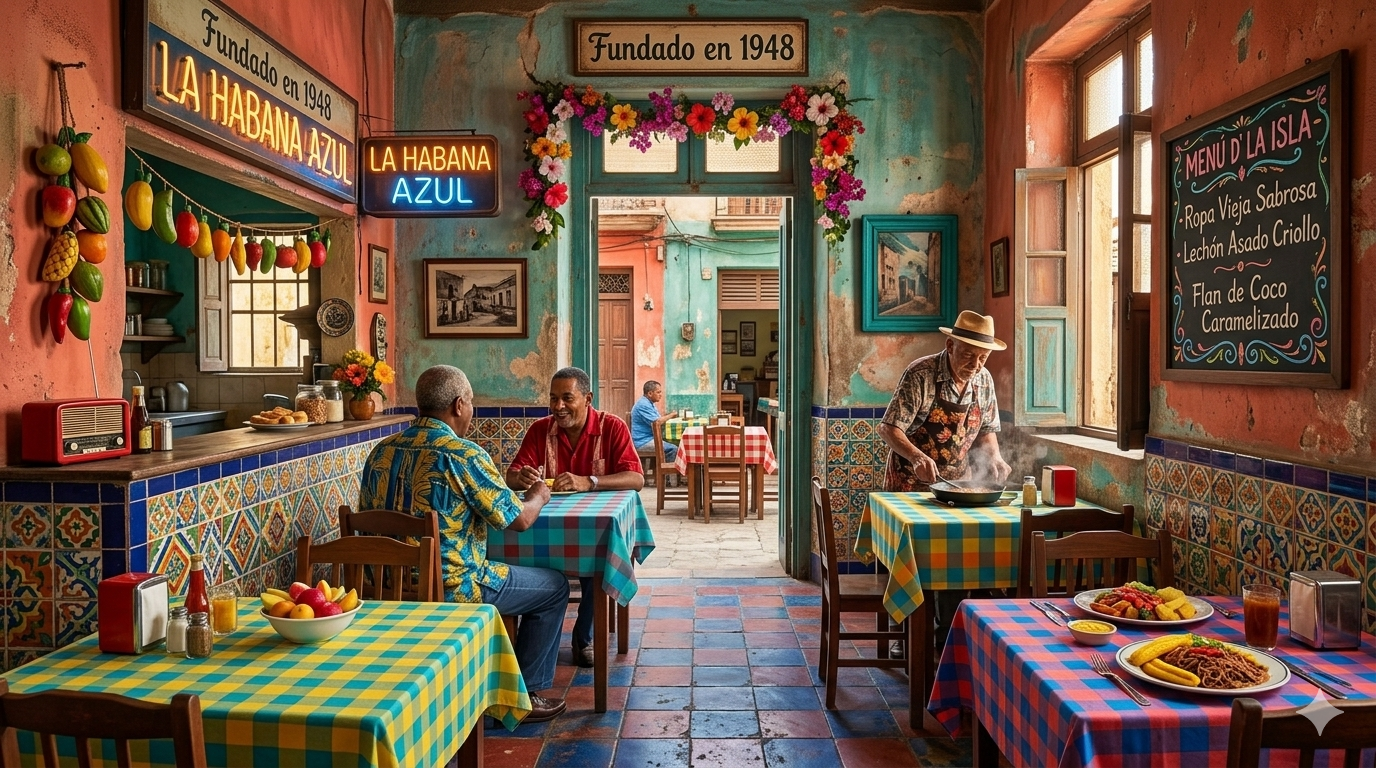
Our Mission
To document, celebrate, and share authentic Cuban food culture , not the tourist version, the real one.
- Traditional recipes, tested and true
- The history behind every dish
- Regional food culture across the island
- The Cuban diaspora's evolving cuisine
- Zero compromise on authenticity